
Higgsfield AI review: the 30% off that is never 30% off
A Higgsfield AI review: 15 video models on one credit balance, rated 4.0 — the breadth is real, the discount badges are not. Who it suits, and who should skip.
Contents
Is Higgsfield AI worth it?

Higgsfield is an AI video-generation aggregator: it resells third-party models like Kling 3.0, Google Veo 3.1 and Seedance 2.5 alongside its own Genjutsu and DoP models, on one credit balance. It sells access rather than a model, which is genuinely useful if you rotate between them instead of committing to one. This Higgsfield AI review scores what you buy at 4.0 rather than the picture it produces, because no generation was run for it. The pricing page ships no prices in its HTML, and once the cards do render, two of its discount claims do not survive contact with its own numbers.
What does Higgsfield actually do?
Open the Video menu and the product explains itself in one screen. Eighteen features run down the left column and fifteen models down the right, and the whole proposition is that they share a wallet.
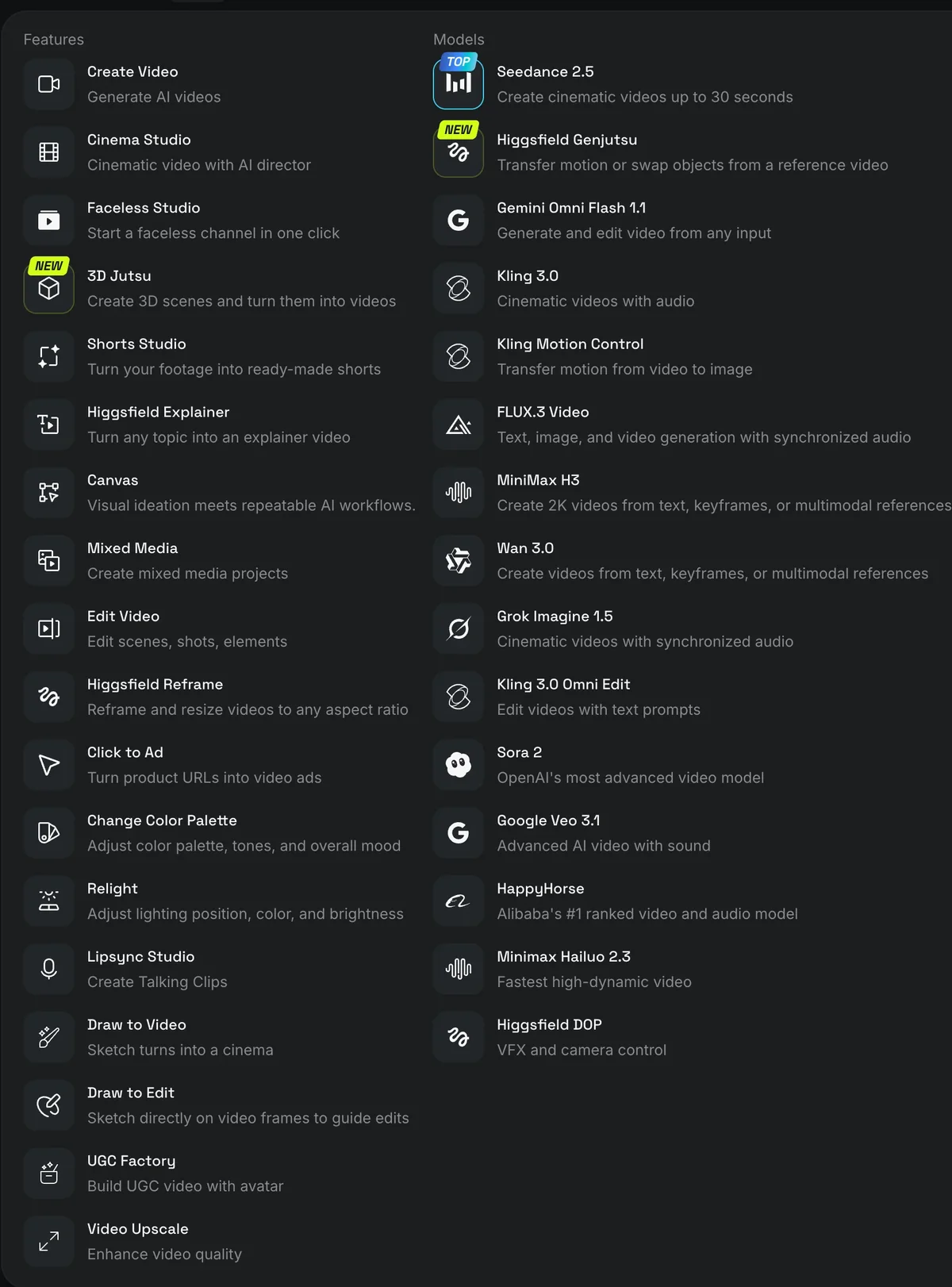
The model column is the part that matters. These are the fifteen video models a Higgsfield subscription reaches:
- Seedance 2.5
- Kling 3.0, Kling Motion Control and Kling 3.0 Omni Edit
- Google Veo 3.1
- Sora 2, but see the note below
- Wan 3.0
- MiniMax H3 and MiniMax Hailuo 2.3
- Grok Imagine 1.5
- Gemini Omni Flash 1.1
- FLUX.3 Video
- HappyHorse
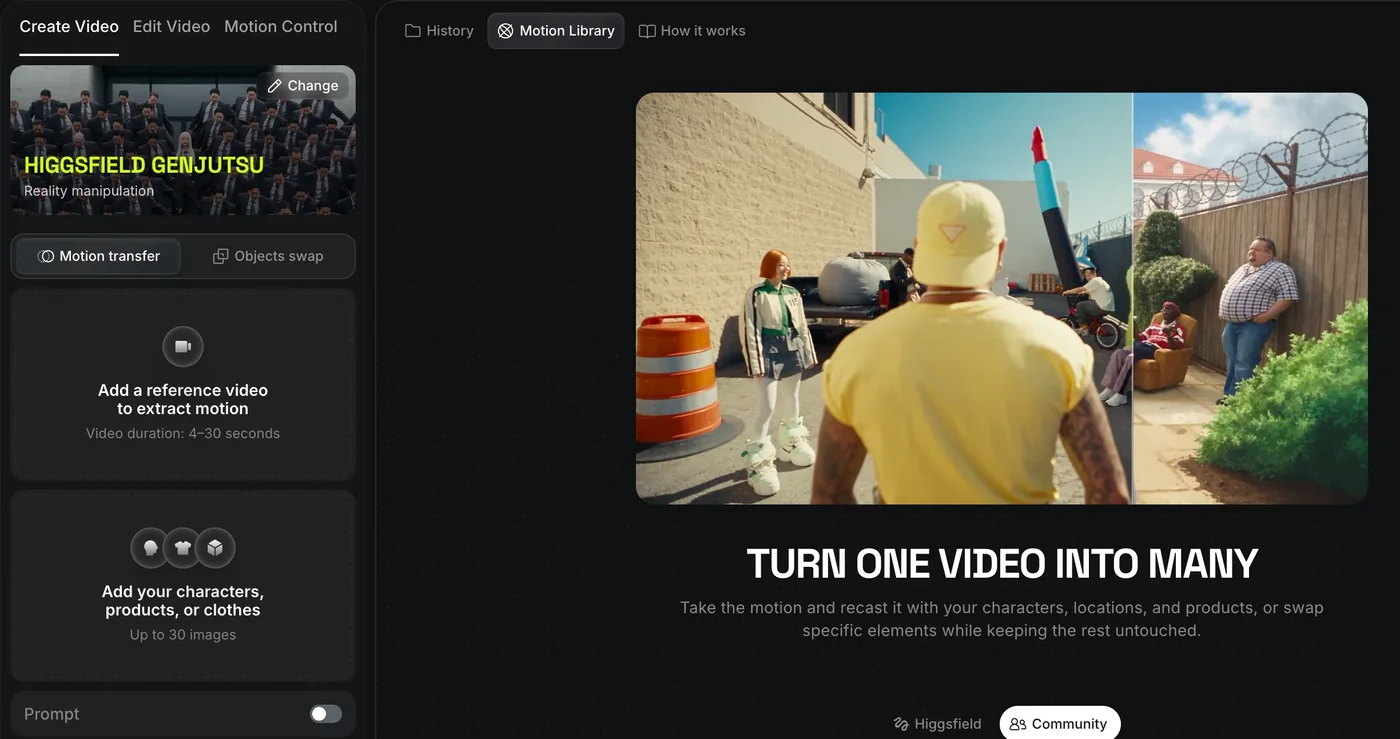
- Higgsfield Genjutsu and Higgsfield DoP, the two house models
That is the menu. The model picker inside Create Video then exposes further variants of the same families that the menu collapses, including Seedance 2.0 with its Fast and Mini versions and a Seedance 2.5 Edit mode, so the number of things you can actually select is higher than fifteen.
One entry on that list is on borrowed time. OpenAI discontinued Sora’s app and website in April and its own notice puts the API’s sunset at 24 September 2026, which is three days after I read this menu. Higgsfield was still listing Sora 2, and still pricing it in the credit table, on 21 September. If Sora access is part of why you are buying, check it still exists before you pay.
Several of those I review on their own terms: Kling, Google Veo and Seedance all have standalone subscriptions you could buy instead.
The feature column is Higgsfield’s own work layered on top. Among the eighteen: Cinema Studio, Faceless Studio, Shorts Studio, UGC Factory, Lipsync Studio, Canvas, Draw to Video, Draw to Edit, Click to Ad, Relight, Change Color Palette, Reframe and Video Upscale. These are workflow wrappers, not models. They pick a model for you, apply a preset, and bill the underlying generation out of the same balance.
That structure is the answer to the obvious question about why anyone would pay a middleman for models they could buy direct. You are not buying the model. You are buying the option to change your mind about which model without opening a second subscription, and a set of presets that saves you from prompt-engineering a camera move from scratch.
The company behind it is not a weekend wrapper. Higgsfield was founded in 2023 by Alex Mashrabov, formerly of Snap, whose earlier company AI Factory built the technology behind Snapchat Cameos. In August 2026 it raised a $400 million Series B at a $5.4 billion valuation, up from $1.3 billion in January. Its own announcement claims $700 million in annualised revenue, more than 30 million users across 238 countries and territories, and visual production for 390 of the Fortune 500.
Those numbers are context for a specific reading of this review: a company that quadrupled its valuation inside a year is going to keep moving its prices, and it does. Everything priced below was read from a signed-in session on 20 September 2026, and I would not assume any of it survives the quarter unchanged.
One boundary before the rest of this. I did not generate anything. The account this was read from holds no credits, and buying them is a transaction I am not going to make on someone else’s card to fill a section. So nothing here comments on motion quality, prompt adherence, character consistency across shots, or how many attempts a usable shot takes. Those are the questions a generation test answers, and this is not one. What follows is what a buyer can verify before paying, which turned out to be the more interesting half.
What you actually pay for Higgsfield
Start with the reason every price you find elsewhere disagrees. higgsfield.ai/pricing ships no prices in its HTML. Fetch the URL and the response carries no plan names and no figures at all; the numbers appear only once JavaScript has run, which takes about five seconds in a browser. Anything reading the page without executing it has nothing to quote, and the spread in published figures shows it.
Here are the three individual plans as the page renders them. Every figure below was read on 20 September 2026.
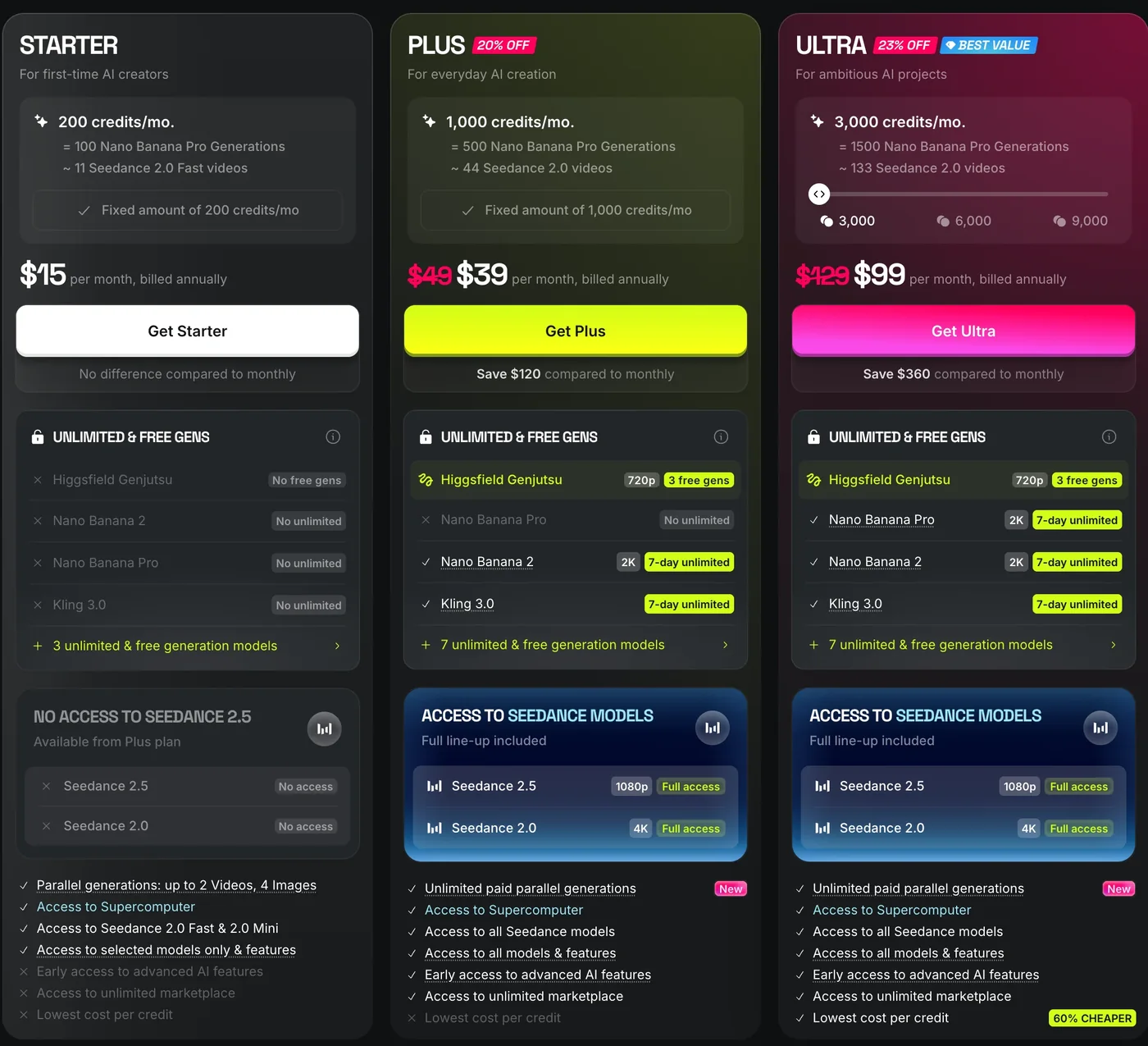
| Plan | Credits / month | Billed annually | Billed monthly | Saving vs renewal price |
|---|---|---|---|---|
| Starter | 200 | $15/mo | $15/mo | none |
| Plus | 1,000 | $39/mo (from $49) | $49/mo | $120/yr |
| Ultra | 3,000 | $99/mo (from $129) | $129/mo | $360/yr |
| Ultra | 6,000 | $194/mo (from $258) | $220/mo, renews $250 | $672/yr |
| Ultra | 9,000 | $270/mo (from $387) | $310/mo, renews $375 | $1,260/yr |
One caveat on that last column: it compares annual against the renewal price, which is how Higgsfield computes it. The 6,000 and 9,000 monthly tiers open at a lower promotional rate, so if that promotion covers only the first month, year one actually saves $642 and $1,195 rather than $672 and $1,260.
Read the Ultra rows twice. The annual card strikes through $258 and $387 as the monthly prices you are being saved from. Switch the toggle to monthly at those same slider positions and the page charges $250 and $375. The struck-through anchors are higher than the prices Higgsfield actually bills.
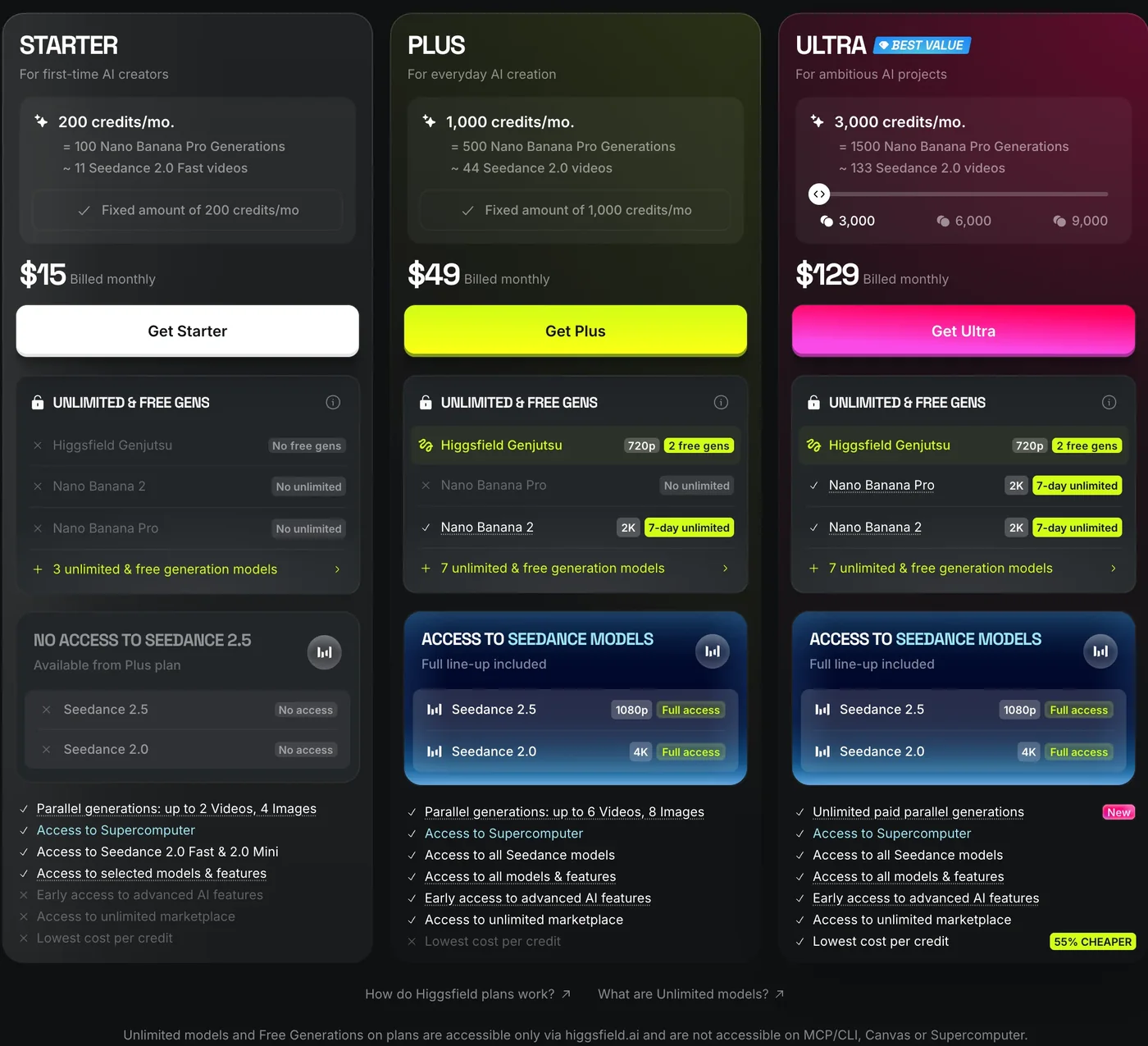
You do not have to take my arithmetic for it, because the card does it for you. The 6,000 tier promises “Save $672 compared to monthly”, and $250 minus $194 is $56, which over twelve months is exactly $672. The 9,000 tier promises “Save $1260”, and $375 minus $270 is $105, which over twelve months is exactly $1,260. The saving lines are computed from $250 and $375. Only the strike-through uses $258 and $387.
The badges follow the inflated anchors rather than the real ones. Ultra at 9,000 wears a “30% OFF” badge, which is accurate against $387 and overstated against the $375 you would otherwise pay. The billing toggle itself carries a standing “30% OFF” label, and no individual plan delivers 30%: Starter saves nothing on annual, Plus saves 20%, and the three Ultra tiers save 23%, 22% and 28% measured against the renewal prices the monthly toggle quotes.
None of that makes annual a bad deal. Annual is a real saving at Plus and above, and the 9,000 tier still saves four figures a year against its own renewal price. It means the discount is smaller than the badge, and it means the monthly tiers above 3,000 credits carry their own promotional opening rate that renews higher, which is the sort of thing you want to know before the second invoice.
What a credit is worth
Credits are the only unit that matters, and their price per unit drops sharply as you climb.
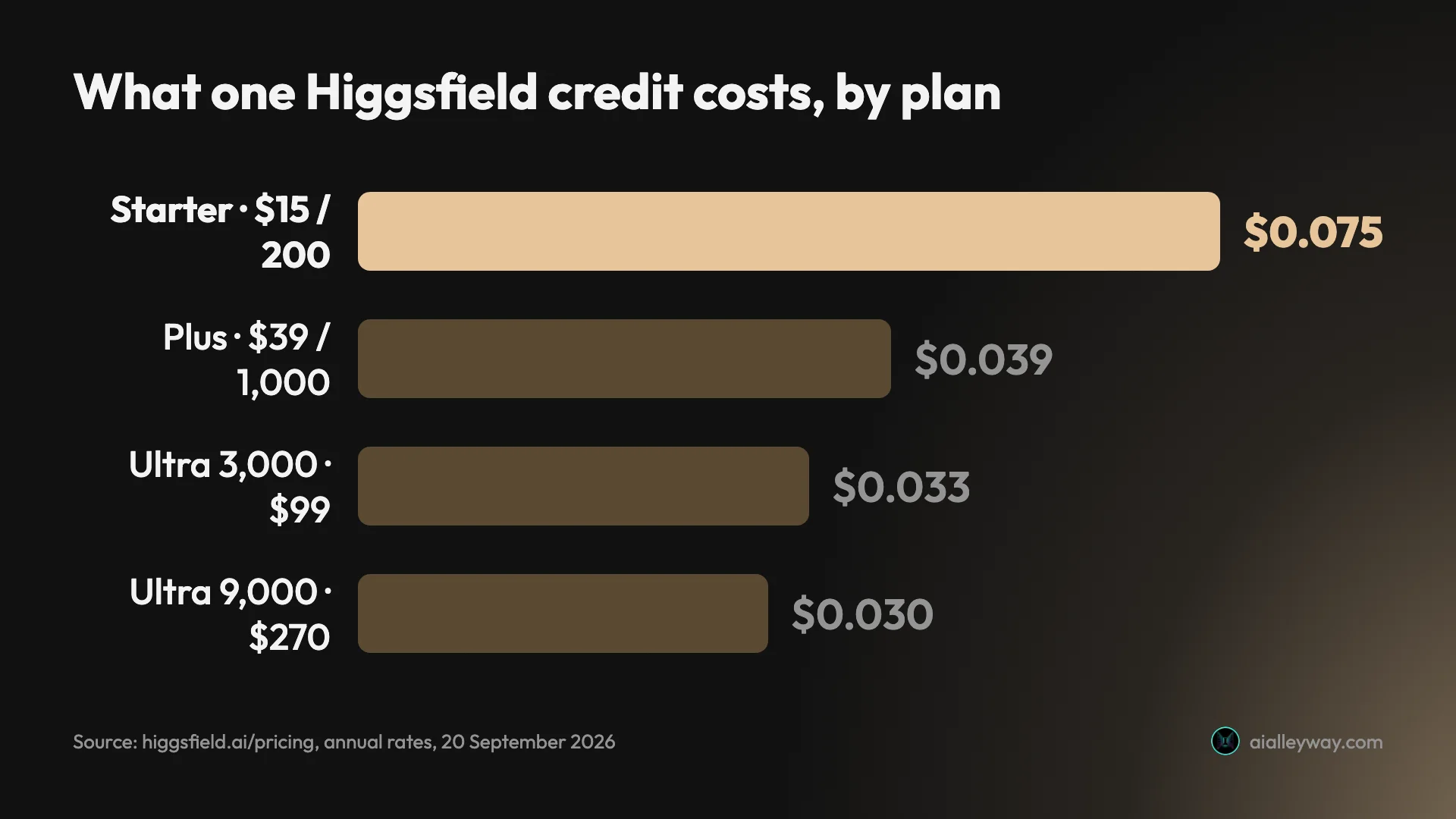
At annual rates, Starter divides to $0.075 a credit. Plus divides to $0.039. Ultra at 3,000 credits is $0.033, and at 9,000 credits it is $0.030. Starter is the same either way, so at the renewal prices the ladder is flatter: $0.075, $0.049, $0.043 and $0.042.
The 9,000 tier opens cheaper than it renews, at $0.034, until that promotional rate lapses. The Ultra card advertises “60% CHEAPER” next to “Lowest cost per credit”, and that claim holds only at the top slider position: $0.030 against Starter’s $0.075 is a 60% reduction, while the 3,000-credit tier the slider opens on is $0.033, which is not.
The genuinely good part of Higgsfield’s pricing is what comes next. Expand the comparison table and it publishes the credit cost of every model at every resolution, before you spend anything. Converted at the Plus annual rate of $0.039 a credit, a working subset of the 20 September 2026 table looks like this.
| Model and setting | Credits | Cost at Plus rate |
|---|---|---|
| Higgsfield Soul 2.0 | 0.12 / image | $0.005 |
| Kling 3.0, 720p | ~7 / 5s | $0.27 |
| Seedance 2.0, 720p | ~22 / 5s | $0.86 |
| Seedance 2.0, 4K | ~110 / 5s | $4.29 |
That is four rows out of a list that runs to dozens. The full per-model table, the image-model rates and the team tiers are in our Higgsfield pricing guide.
The spread across that table is the actual buying decision. A five-second Kling 3.0 shot at 720p costs 27 cents of your allowance and a five-second Seedance 2.0 shot at 4K costs $4.29. Those are the same length of video from the same subscription, and at 110 credits a go the 4K one would overrun a Starter plan’s whole 200-credit month on the second attempt, if Starter could run it at all, which it cannot.
Which is the honest way to think about the cost-per-usable-shot question that dominates discussion of this tool. Google’s AI Overview for “higgsfield ai review” leads with an “iteration tax”, claiming real usage takes three to four attempts per keeper. I cannot confirm that number, and neither can the write-ups it is quoted from, because it traces back to a forum thread rather than a count. What the table above does let you do is build your own bracket: pick your model row, multiply by however many attempts your own work usually takes, and you have a per-shot figure that does not depend on anyone’s anecdote.
The part that expires
Credits do not roll over. Higgsfield’s pricing FAQ states it twice in one answer, once as “Subscription credits do not roll over and expire at the end of each credit cycle” and again as “Unused subscription credits do not roll over to the next billing cycle and expire at the end of each month.”
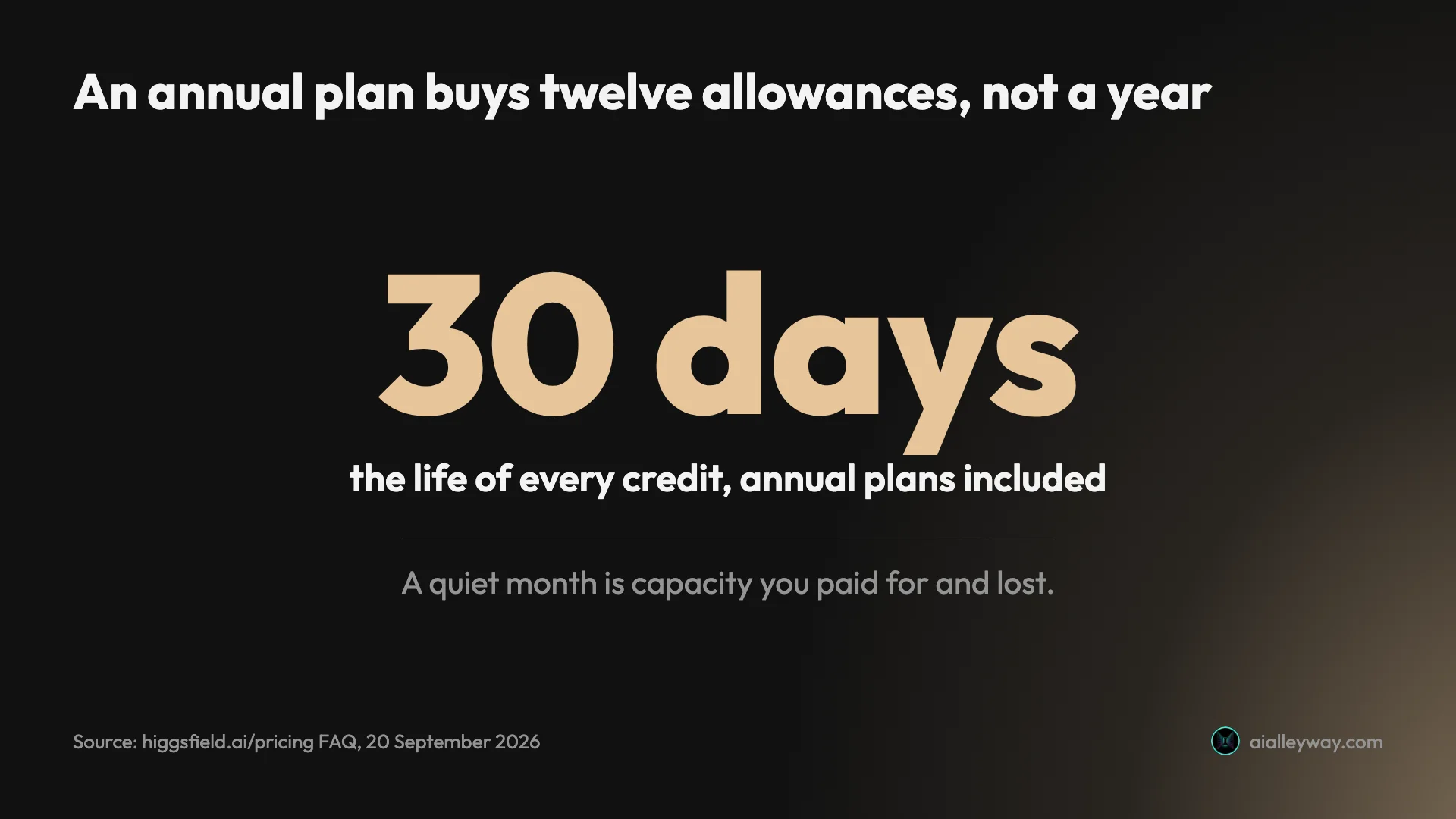
For an annual subscriber that is the single most expensive sentence on the page. The same answer specifies that on annual plans, credits refresh every 30 days from the subscription start date. Paying twelve months up front does not buy 12,000 credits on a Plus plan to spend as the work arrives. It buys 1,000 credits, twelve separate times, each with a 30-day fuse. A quiet month is paid-for capacity that evaporates, and a heavy month cannot draw on it.
Prices also exclude VAT and local taxes, added at checkout, which the page states in a footnote under the cards.
Credit packs, and how many jobs run at once
Running out mid-project has two exits. The FAQ describes both: upgrade the plan “for a higher monthly limit”, or “buy credit packs to generate more media without changing your current subscription”, with purchased credits “added instantly” and usable across every supported model.
What that answer does not settle is whether a purchased pack expires on the same 30-day clock as a subscription allowance. It is the one pricing question the page would not answer, and the guide works through what it means for a heavy month.
The full ladder, including the Team and Scale seat pricing and what a month of credits buys at each tier, is in our Higgsfield pricing guide.
The other plan gate that bites during real work is concurrency, and it is graded hard.
| Plan | Video jobs | Image jobs | Lipsync jobs | Character jobs | Character generation cap |
|---|---|---|---|---|---|
| Starter | 2 | 4 | 2 | 1 | up to 80 |
| Plus | 6 | 8 | 6 | 3 | up to 400 |
| Ultra | 8 | 8 | 8 | 3 | up to 1,200 |
Ultra’s card additionally advertises unlimited paid parallel generations on top of that row, and the Plus card states its own limit on the front as up to 6 videos and 8 images.
For iterative work that ladder matters more than the credit price. Queuing six variations of a shot and picking the best is a different working rhythm from queuing two, and it is the sort of limit that only announces itself once you are already paying.
Who is Higgsfield for?
- The model-undecided. If you genuinely do not know whether a shot wants Kling’s motion or Seedance’s fidelity, one balance across both is worth more than the cheapest single subscription. This is the strongest case for the product and the one its structure is built around.
- High-volume image work. Higgsfield Soul 2.0 at 0.12 credits an image works out near half a cent at the Plus rate. If your output is stills at volume rather than hero video shots, the credit maths tips heavily in your favour.
- Teams already past 3,000 credits a month. The per-credit price only falls meaningfully at Ultra, and Ultra’s slider makes 6,000 and 9,000 credit tiers available without a sales call.
- Preset-driven production. Shorts Studio, UGC Factory, Click to Ad and Lipsync Studio are the reason to pay a middleman. If you would otherwise be hand-rolling those workflows across three tools, the wrapper earns its margin.
- Not for: anyone whose monthly usage is lumpy. The 30-day expiry punishes irregular work harder than almost any competitor’s billing. If you shoot in bursts with quiet months between, you are buying capacity you will forfeit, and a pay-as-you-go model direct from one provider will cost less.
What does Higgsfield get right?
One balance, fifteen video models
The picker is where that balance pays off. Opening the model list inside Create Video shows the full shelf with resolution and duration chips attached to each entry, and switching between them costs nothing but a different credit rate.
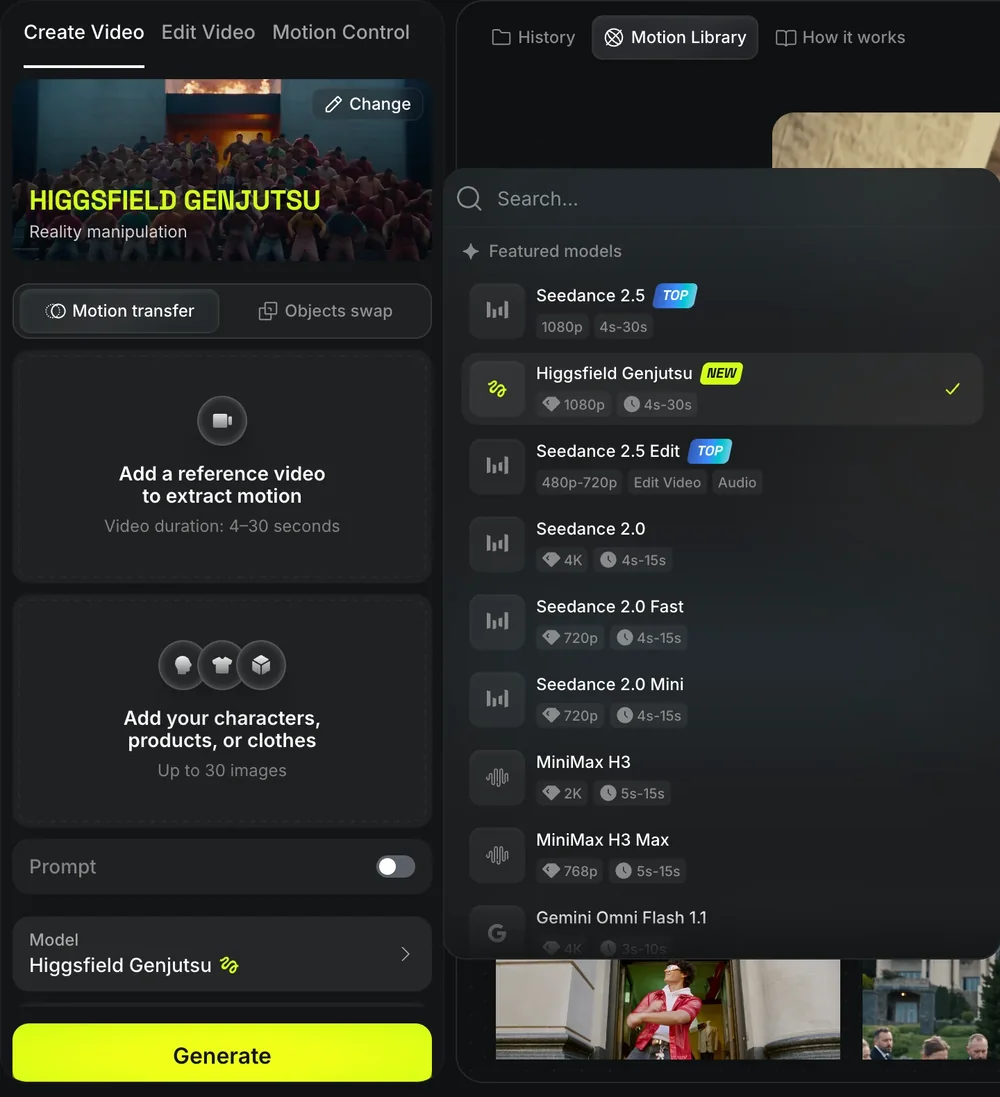
The alternative is four subscriptions with four billing dates and four unused remainders. For anyone who actually rotates models, that consolidation is the whole value proposition and it is delivered cleanly.
The plan recommender estimates your spend before you pay
Under the cards sits a three-step wizard that most tools in this category do not bother with. It asks what you are here to make, how many items a month you need, and which capabilities you want, then projects your usage against a plan. Mine came back with “Expected monthly usage 820/1,000 credits” and a recommendation of Plus, which is a far more useful answer than a feature matrix.
It also publishes its own conversion rates as you move the sliders, quoting roughly 14 credits per Kling 3.0 generation at 8 seconds and 720p, and 2 credits per Nano Banana Pro image. The Kling figure sits oddly against the comparison table below it, which prices Kling 3.0 at 720p at about 7 credits per 5 seconds. Use the comparison table when the two disagree, since it is the one broken out by resolution.
Per-model credit costs are published before you spend
The comparison table on the pricing page lists every model at every resolution with its credit cost, down to fractions: Wan 3.0 at 480p is 5 credits per 5 seconds, at 720p it is 8.75. That level of disclosure is unusual, and it is the thing that makes the cost-per-shot arithmetic in this review possible at all.
It is most striking in the span. The cheapest and dearest things you can make on one subscription are three orders of magnitude apart, and Higgsfield tells you so before you spend anything.
| Cheapest | Dearest | Ratio |
|---|---|---|
| Higgsfield Soul 2.0, 0.12 credits an image | Seedance 2.0 at 4K, ~110 credits per 5s | about 900× |
The nine image models and their individual rates are tabled in the pricing guide.
The per-credit price genuinely falls with scale
On annual billing, moving from Starter to Ultra at 9,000 credits takes the unit price from $0.075 to $0.030. Plenty of tools advertise volume pricing and deliver a rounding error. This one is a real reduction, and the slider exposes the top of it without a sales conversation.
It gets the two hardest billing moments right
Metered products usually fail at the same two points: spending money before you knew the price, and waiting for a renewal to get capacity you need now. Higgsfield handles both.
On its Supercomputer surface the FAQ says the interface shows “the credit cost upfront — before anything renders. You approve the spend, then it generates.” Approving a quote before credits leave the balance is the correct design for anything metered, and it is the one feature most likely to blunt the cost-per-attempt complaint for people working on that surface.
Mid-cycle plan changes follow the same logic. Upgrading “takes effect immediately, and any credit difference is applied to your account”, while downgrades wait until the end of the current period. A project that outgrows its plan on the 8th gets the credits on the 8th, which is exactly the behaviour the 30-day expiry rule makes necessary.
The free-generation allowances are visible in the interface
Models that carry a free allowance show it as a labelled toggle in the create panel with the remaining count printed on it, so you can see what a run will draw on before you start it. It is a small thing, and on a product where the main complaint is unexpected spend, it is the right small thing.
Where does Higgsfield fall short?
Every fault below is one a buyer can verify before paying, because no generation was run for this review. Output quality is not on this list.
The prices are not in the page, only in the JavaScript
Fetch higgsfield.ai/pricing and the response contains no plan names and no figures, with a Googlebot user-agent as well as a plain one. In a browser the cards take roughly five seconds to appear, and until they do the page is a grey skeleton. A human who waits gets the prices whether signed in or not, but anything that reads the HTML without running it gets nothing from the site’s highest-intent page.
The downstream damage is easy to see anywhere Higgsfield’s pricing gets written up, where the published figures contradict each other in every direction and Google’s AI Overview hedges into ranges rather than committing to a number. Googlebot runs JavaScript, so this is not a problem for Google’s own index; it is a problem for every scraper, quoting tool and write-up that reads the HTML and finds nothing. A product this widely covered should not make its own prices unquotable.
The discounts are measured against prices Higgsfield does not charge
At Ultra’s 6,000 and 9,000 credit tiers, the annual view strikes through $258 and $387. The monthly view of the same tiers charges $250 and $375. The card’s own “Save $672” and “Save $1260” lines are computed from $250 and $375, so the page carries both the real number and the inflated one at the same time.
The badges inherit the inflation. The billing toggle wears a standing 30% badge, repeated under the comparison table as “Annual 30% OFF”. Measured against the renewal prices the monthly toggle quotes, Starter saves nothing, Plus saves 20%, and the Ultra tiers save 23%, 22% and 28%. Not one of the five plan-and-tier combinations on the page reaches 30%.
Credits expire every 30 days, including on annual plans
This is the defect most likely to cost a real buyer real money, so it belongs in both sections. Higgsfield’s pricing FAQ says subscription credits do not roll over and expire at the end of each credit cycle, and that on annual plans the cycle is 30 days from the subscription start date. Twelve months paid in advance buys twelve 30-day allowances, not a year of capacity. Credit expiry is one of the recurring themes in the one-star reviews, and the policy is doing exactly what it says it will.
“Unlimited” is the standard queue, and credits are the priority one
This is stated by Higgsfield rather than inferred: “Unlimited generations run in the standard queue, while credit-based generations always run in the priority queue.” The same answer presents Credit Mode as the remedy, a way to “bypass the standard queue and return to maximum speed instantly.”
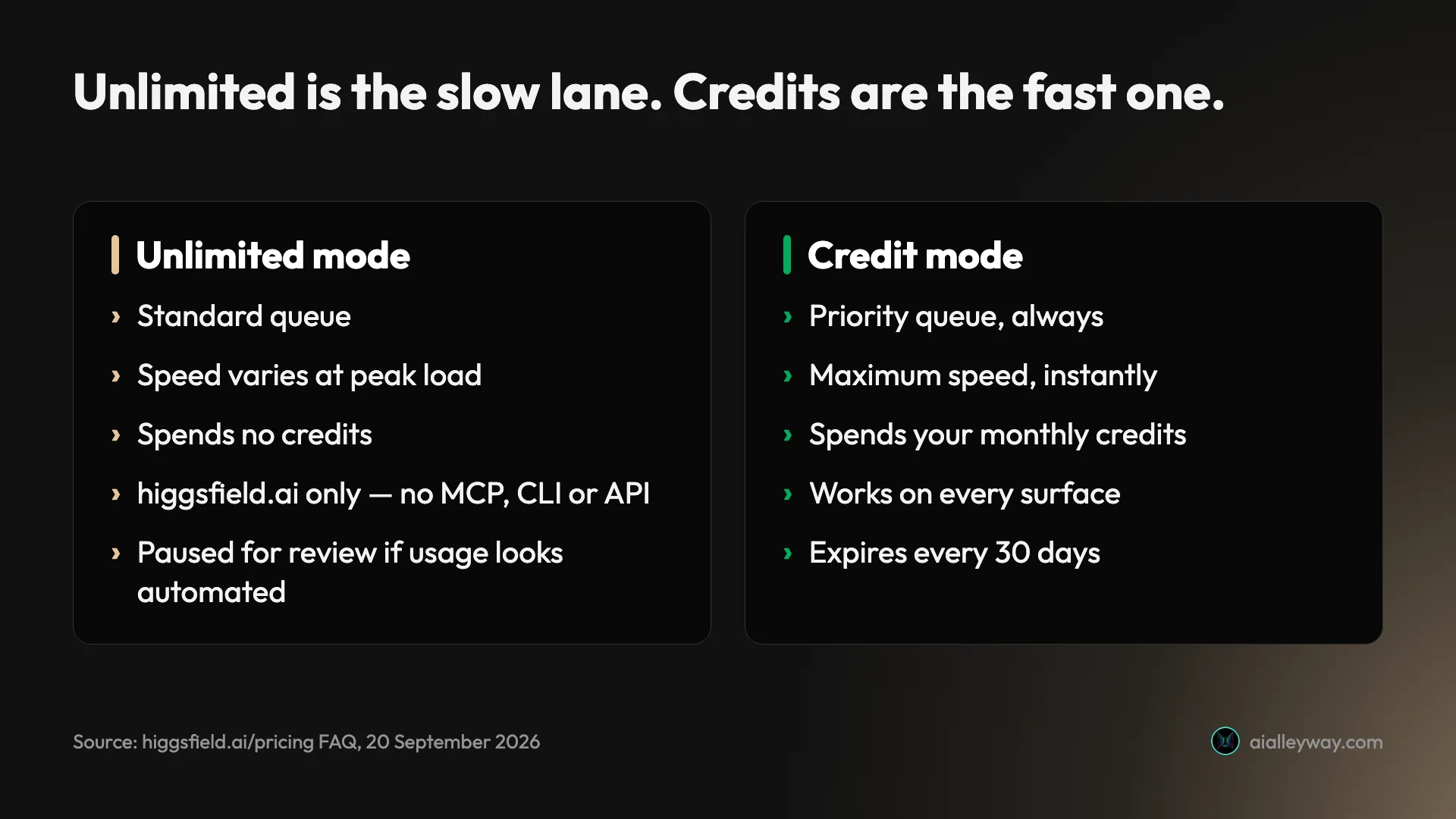
Two further constraints ride along with it. Unlimited models and free generations are available only on higgsfield.ai, explicitly not through MCP, CLI, Canvas or Supercomputer, so an unlimited plan does nothing for an automated pipeline. And unlimited access can be paused for manual review when usage looks automated, restored once a human confirms otherwise.
The 365 Unlimited promo ends the moment your plan does
Higgsfield periodically runs a promotion granting a full year of unlimited generations on the models listed on each plan card, and as the terms stood on 20 September 2026 it stacks: the FAQ says every time the promo activates, active subscribers on eligible plans get another 12-month extension.
The terms underneath are strict in one direction and generous in the other. Upgrade and the unlimited access continues for the full twelve months. Cancel, or move to a lower plan that does not include the promo, and unlimited access “stops immediately when your current plan ends”. So the year is a year of continuous subscription rather than a year you own. Anyone treating a stacked promo as banked value should read that clause before planning around it, because the asset disappears with the plan that carried it.
Trustpilot’s 4.0 is built from both ends
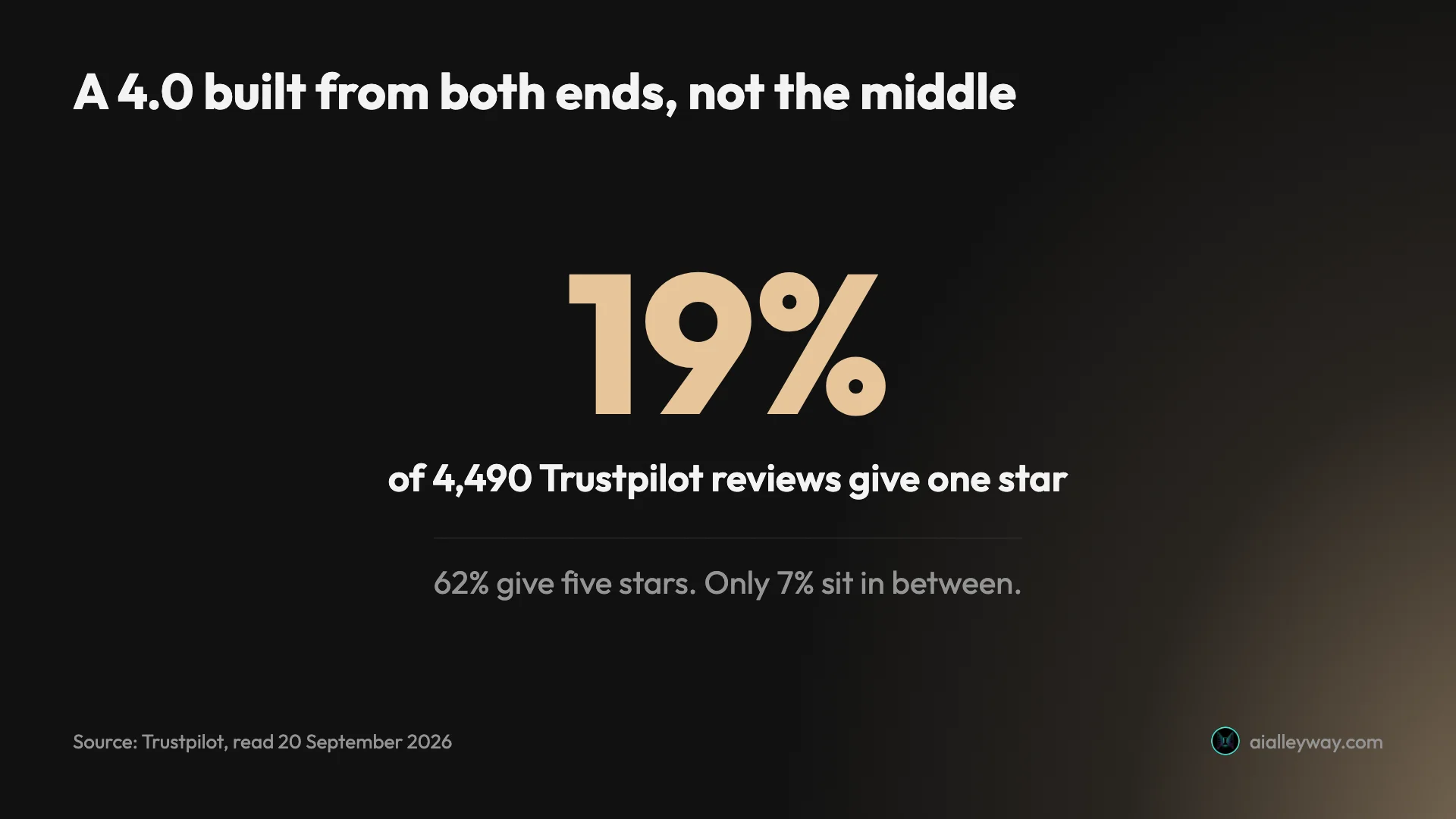
Higgsfield averages 4.0 across 4,490 Trustpilot reviews, read on 20 September 2026. It is the only aggregate cited here: G2 also carries a Higgsfield profile, but it refuses automated requests, so nothing from it was checked for this review. The distribution behind that average is 62% five-star and 19% one-star, with 12% at four and only 7% across the two middle bands. Nearly one Higgsfield review in five gives it the lowest score the platform offers.
The one-star reviews are consistent about their subject, and it is not picture quality. They name confusing subscription terms, unexpected charges, credits expiring unused, difficulty getting refunds, and slow support. Subscriptions renew automatically, which the FAQ confirms, so the cancellation has to be deliberate.
Starter is the wrong plan for what Starter is sold as
Pitched “for first-time AI creators”, this is the one plan you should probably skip. The annual discount does not apply to it at all, its own card saying “No difference compared to monthly”, and $0.075 is the highest per-credit price on the page. Seedance 2.5 and Seedance 2.0 are both marked “No access”, leaving only the Fast and Mini variants. There are no unlimited models, no free Genjutsu generations, and parallel work caps at 2 videos and 4 images.
At $15 a month for 200 credits, a single 4K Seedance shot would consume more than half the allowance if the plan could run one, which it cannot. Testing the product on Starter would tell you very little about the product.
If Higgsfield is not the right buy
If the credit model or the expiry policy rules Higgsfield out, the sensible move is to stop paying a middleman and go direct to whichever model you were reaching for. Our Higgsfield alternatives roundup tests seven of them hands-on; the three that come up most are below.
Kling is the one most Higgsfield users are actually asking about, and it sits inside Higgsfield’s own picker at roughly 7 credits per 5 seconds at 720p. Buying it direct gets you its full feature surface and its own billing, which suits anyone who has already settled on Kling and stopped shopping.
Google Veo is the other model worth buying on its own terms, particularly if synchronised audio matters to your work. Inside Higgsfield it runs about 29 credits per 4 seconds at 720p, with a Fast variant at 11, so it is one of the more expensive rows in the table to iterate on through an aggregator.
Runway solves a different problem and is worth naming for that reason. If your bottleneck is editing and reworking existing footage rather than generating new shots, its editing tools are the better fit and no amount of model breadth substitutes for them.
Final word
Higgsfield earns its 4.0 here on breadth and disclosure, and is kept out of the band above it by how it presents its own prices. Fifteen video models on one balance is a real product with a real argument behind it, the per-model credit costs are published to two decimal places, and the per-credit price genuinely falls by more than half between Starter and the top of Ultra on annual billing. That is more than most of this category offers.
What stops it going higher is that the page selling all of this strikes through prices it does not charge, advertises a 30% discount that no plan delivers, publishes no prices anywhere in its HTML, and quietly expires your credits every 30 days on a plan you paid for by the year. None of that is fatal, and all of it is knowable in advance now. Buy at Plus or above, set a calendar reminder for the renewal date, and spend the allowance inside its 30 days.
Frequently asked questions
How much does Higgsfield AI cost?
Three individual plans, and the number you find elsewhere is probably wrong, because the pricing page ships no prices in its HTML at all and only fills them in once JavaScript has run. Read live on 20 September 2026: Starter $15 a month for 200 credits, Plus $39 billed annually or $49 monthly for 1,000, and Ultra from $99 annually for 3,000, sliding up to $270 for 9,000. Our Higgsfield pricing guide carries the full ladder, including the team tiers and the monthly renewal prices, which differ from the opening ones on the larger Ultra steps.
Prices exclude VAT and local taxes, which the page states in its own footnote and adds at checkout. There is no free plan that renews. New accounts get a small trial allotment, and once it is gone the app shows a persistent Upgrade prompt rather than a monthly refill.
Do Higgsfield credits roll over?
No, and this catches annual subscribers hardest. Higgsfield's own pricing FAQ says it twice in the same answer: "Subscription credits do not roll over and expire at the end of each credit cycle", and "Unused subscription credits do not roll over to the next billing cycle and expire at the end of each month."
The part worth reading twice is what a cycle means on an annual plan. The same answer says that for annual plans, credits refresh every 30 days from the subscription start date. So paying a year up front buys twelve separate 30-day allowances, not one pooled year of credits. A quiet month is money you have already paid and cannot recover, and a busy month cannot borrow from it. Credit expiry is one of the recurring themes in Higgsfield's one-star Trustpilot reviews, and the policy is the reason, not a support failure.
What does unlimited mean on a Higgsfield plan?
It means free of credits, not free of queue. Higgsfield's pricing FAQ states the trade directly: "Unlimited generations run in the standard queue, while credit-based generations always run in the priority queue." The same answer offers Credit Mode as the fix, describing it as a way to "bypass the standard queue and return to maximum speed instantly."
Three further limits sit alongside it. Generation speed and concurrency may vary during high load. Unlimited models and free generations work only on higgsfield.ai and are not available through MCP, CLI, Canvas or Supercomputer, so an unlimited plan does not make an automated pipeline free. And unlimited access can be paused for manual review if usage looks automated. Unlimited is a real saving on a plan you are already paying for. It is not a speed tier.
Is Higgsfield AI better than Kling?
That question has a category error inside it, because Higgsfield sells Kling. Kling 3.0 is one of the 15 video models in Higgsfield's picker, alongside Google Veo 3.1, Seedance 2.5, Wan 3.0, MiniMax Hailuo 2.3 and Higgsfield's own Genjutsu and DoP models. Choosing between them is not a quality comparison, it is a question of whether you want one model or a shelf of them.
Go direct to Kling if you have settled on Kling and want its full feature surface at its own price. Come to Higgsfield if you do not know which model suits a shot yet, or if you switch often enough that maintaining several subscriptions costs more than one credit balance. The second case is the real argument for an aggregator, and it gets stronger the more models you genuinely rotate through.
Is Higgsfield AI safe and legitimate?
It is a real, heavily funded company rather than a thin wrapper. Higgsfield was founded in 2023 by Alex Mashrabov, previously of Snap, where his earlier company AI Factory built the technology behind Snapchat Cameos. In August 2026 it raised a $400 million Series B at a $5.4 billion valuation, up from $1.3 billion in January, and reported $700 million in annualised revenue.
Safety in the other sense is a mixed picture. Trustpilot averages 4.0 across 4,490 reviews, but the distribution is unusual: 62% five-star against 19% one-star, with only 7% in the two middle bands. The one-star reviews cluster on billing rather than output, naming unexpected charges, credits expiring unused, and slow refunds. Subscriptions renew automatically, which the FAQ states plainly, so cancel deliberately rather than by lapsing.
Does Higgsfield have a free plan?
Not a renewing one. A new account gets a small trial allotment of credits, and some models carry a separate free-generation allowance that shows up in the interface as a toggle marked with the number remaining. Once those are spent the app runs a persistent banner reading "Credits are running low! All credits used" with an Upgrade button, and no monthly refill arrives.
The free-generation allowances are also billing-term dependent, which is easy to miss. On the annual view of the pricing page, the Plus plan lists three free Higgsfield Genjutsu generations at 720p. Switch the same card to monthly and it lists two. That is a small difference in absolute terms, but it is a difference the toggle does not announce, and it is the kind of detail that only shows up when you compare both states of the card.
Keep reading
Higgsfield pricing: what a credit actually costs you
Higgsfield pricing read off the live page: $15 to $270 a month solo, $65 a seat for teams, and the plan that looks cheapest is the worst value per credit.
The Best AI Video Generator for Every Kind of Video
The best AI video generator depends on the job. We tested 10 hands-on: Google Veo for generation, Synthesia for avatars, Fliki for script-to-video, and more.
Kling AI Review: The Best AI Video, and a Billing Problem
Kling AI makes some of the best AI video anywhere, but one free clip cost 60 of my 66 credits. My hands-on take on quality, credits, and trust issues.
Seedance Review: The Best Video Model You Can't Easily Use
Seedance makes some of the best AI video anywhere for about $0.62 a clip, but its own app gates it behind a paywall. My hands-on take on quality and price.